


B2B Customer Experience and User Testing: An Analytical Report on Market Adoption, Design Frameworks, and Commercial ROI
The global business-to-business (B2B) ecosystem is currently navigating a period of profound structural realignment.
As digital interactions become the primary medium for transaction and relationship management, the traditional "product-first" industrial mindset is being forcibly supplanted by a "user-centric" paradigm.
This transition is not merely cosmetic; it is a fundamental shift in how value is perceived and captured in professional markets.
Despite the escalating importance of digital interfaces, a significant discrepancy remains between the strategic necessity of user experience (UX) and its operational execution.
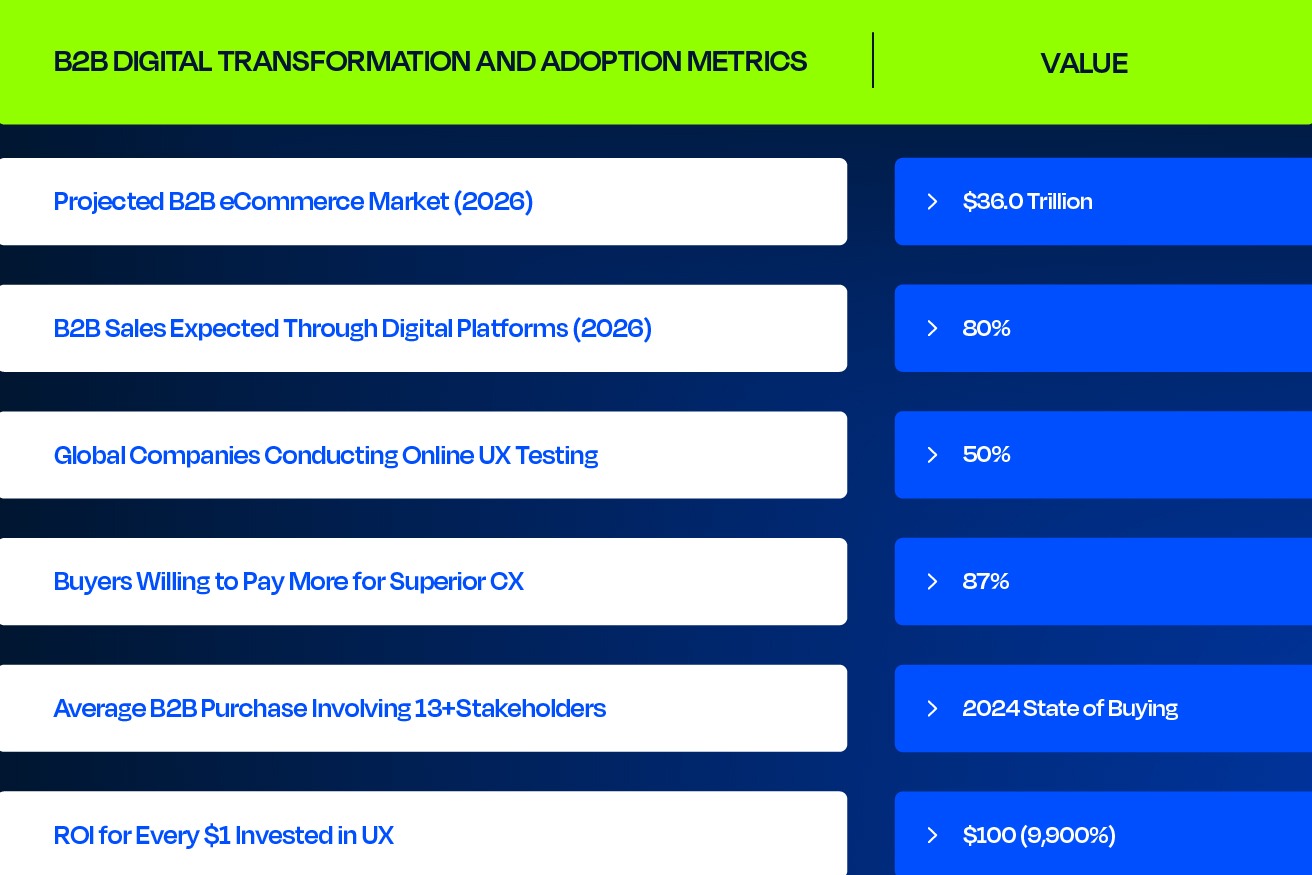
Current data reveals that only 50% of B2B companies worldwide conduct online user testing, representing a critical failure in market adaptation that exposes the remaining half to substantial competitive risk.
The Adoption crisis: The 50 Percent Barrier in B2B UX testing
The B2B sector has historically operated under the assumption that professional purchasers are purely rational actors driven by technical specifications and price points.
This legacy perspective has fostered a corporate culture that prioritizes product promotion over the understanding of user behavior.
However, the modern B2B buyer journey has shifted toward a self-guided, digital-first model where 83% of the journey is spent researching independently, often without any direct sales interaction. In this environment, the digital interface acts as the primary surrogate for the sales representative. Yet, the data concerning the adoption of evidence-based design practices suggests a widespread lack of readiness.
The current state of adoption is defined by a stark divide: while 87% of B2B buyers are willing to pay a premium for suppliers who deliver an outstanding customer experience, only half of organizations actively validate their digital experiences through online user testing.
This means that 50% of B2B companies are deploying multi-million dollar digital platforms based on internal assumptions rather than empirical user data.
This "testing gap" is particularly acute in industrial B2B sectors, where traditional corporate culture tends to view digital tools as catalogs rather than interactive services.
The failure to conduct rigorous UX testing leads to significant "cognitive friction" in the buying process. Evergreen McKinsey research identifies the "lack of speed" in interactions as the number-one pain point for B2B decision-makers, mentioned twice as often as price.
When digital interfaces are not optimized through testing, they become bottlenecks rather than facilitators. This is exacerbated by the increasing complexity of buying committees. With an average of 13 stakeholders involved in a single B2B purchase, a single point of failure in the user experience can derail a high-value contract.
The arguments for closing this testing gap are anchored in the high cost of failure.
88% of internet users are less likely to return to a website after a single poor experience, and 89% of buyers will switch to a competitor following a subpar interaction.
In the B2B context, where the median conversion rate is a modest 2.9%, every lost visitor represents a substantial loss in potential lifetime value.
Companies that fail to test their interfaces are effectively invisible to the 89% of buyers who now use generative AI and digital research as their primary research interface.
Structural Frameworks of Customer Experience Design
What is Customer Experience Design?
Customer Experience (CX) Design is a comprehensive methodology focused on the strategic orchestration of every touchpoint between a brand and its customers.
While UX design focuses on specific interactions within a product or interface, CX design addresses the entire relationship lifecycle, from discovery and evaluation to onboarding and long-term support.
Authority in this field is established by frameworks from Gartner, Forrester, and McKinsey, which provide the structural rigor necessary for industrial applications.
Gartner defines CX as the perception customers have of their interactions with an organization, while Forrester emphasizes the effectiveness, ease, and emotional impact of those interactions.
For any B2B company on the planet, CX design is not an accidental outcome but a deliberate architecture that must be engineered through specific, repeatable phases.
The Six-step B2B Customer Experience Design Process
The implementation of a mature CX strategy follows a logical progression that aligns user needs with business objectives.
This process ensures that every digital and physical interaction reinforces the brand promise and reduces transaction costs.
Phase 1: User Persona Analysis and Stakeholder Mapping
The foundation of CX design is a deep understanding of who the users are.
In B2B, this is more complex than in B2C because of the "stakeholder gap."
Organizations often focus exclusively on the procurement manager (the buyer) while ignoring the actual engineers, operators, or administrative staff (the users) who will interact with the product daily.
"After all, the professional who uses a warehouse management system from 9 to 5 deserves the same ease of use and visual appeal as an experience on Instagram or Netflix. Every digital experience that Krein design starts with a deep understanding of the industry, language, and behavior of key decision-makers". ~ Lapo Chirici, Krein CEO, in an interview featured in Panorama.
A rigorous persona analysis identifies real needs and behaviors to build a solid strategic base. High-performing companies analyze transaction logs and conduct primary research to develop integrated buyer and user personas.
These personas must capture not just demographics, but also motivations, decision-making power, and specific pain points. McKinsey research notes that failing to approach users behind procurement often results in lost insights that are critical for long-term retention.
Phase 2: UX Research and Journey Wireframing
Once personas are established, the next phase involves mapping the customer journey — the sequence of interactions from the "Before" (needs recognition) to the
"During" (search and selection) and the "After" (post-sale activity). This phase uses research to map user paths and create intuitive navigation flows.
Current trends show that B2B buyers engage with 3 to 7 pieces of content before ever speaking to a sales representative.
Wireframing must therefore prioritize information architecture that allows for "representative-free" exploration. Gartner research highlights that 75% of B2B buyers now prefer a digital-first, rep-free sales experience, making the intuitive design of self-service portals a critical requirement.
Phase 3: Design System and Tone of Voice
Consistency is a prerequisite for trust in professional markets. A Design System establishes a unified visual and verbal identity across all platforms, ensuring that a user’s experience on a mobile app matches their experience on a desktop portal or a physical product interface.
Tone of Voice is equally critical; it must be clear, concise, and persuasive, avoiding the jargon-heavy "industry-speak" that often obscures value.
Phase 4: UI Design and Prototyping
Prototyping brings the digital product to life with clear, high-impact interfaces. This phase translates strategic insights into tangible designs that can be visualized and critiqued. The goal of UI design in B2B is to make complex tasks feel effortless.
This is achieved through "natural interaction" design — planning forms, buttons, and menus so that every action feels smooth and purposeful.
Phase 5: Testing and Validation
This is the most critical and often overlooked phase. Testing and validation involve refining the product based on real feedback rather than hypotheses.
In the B2B world, where sample sizes are often small, organizations must use qualitative insights and "small sample CRO" (Conversion Rate Optimization) techniques to detect usability issues.
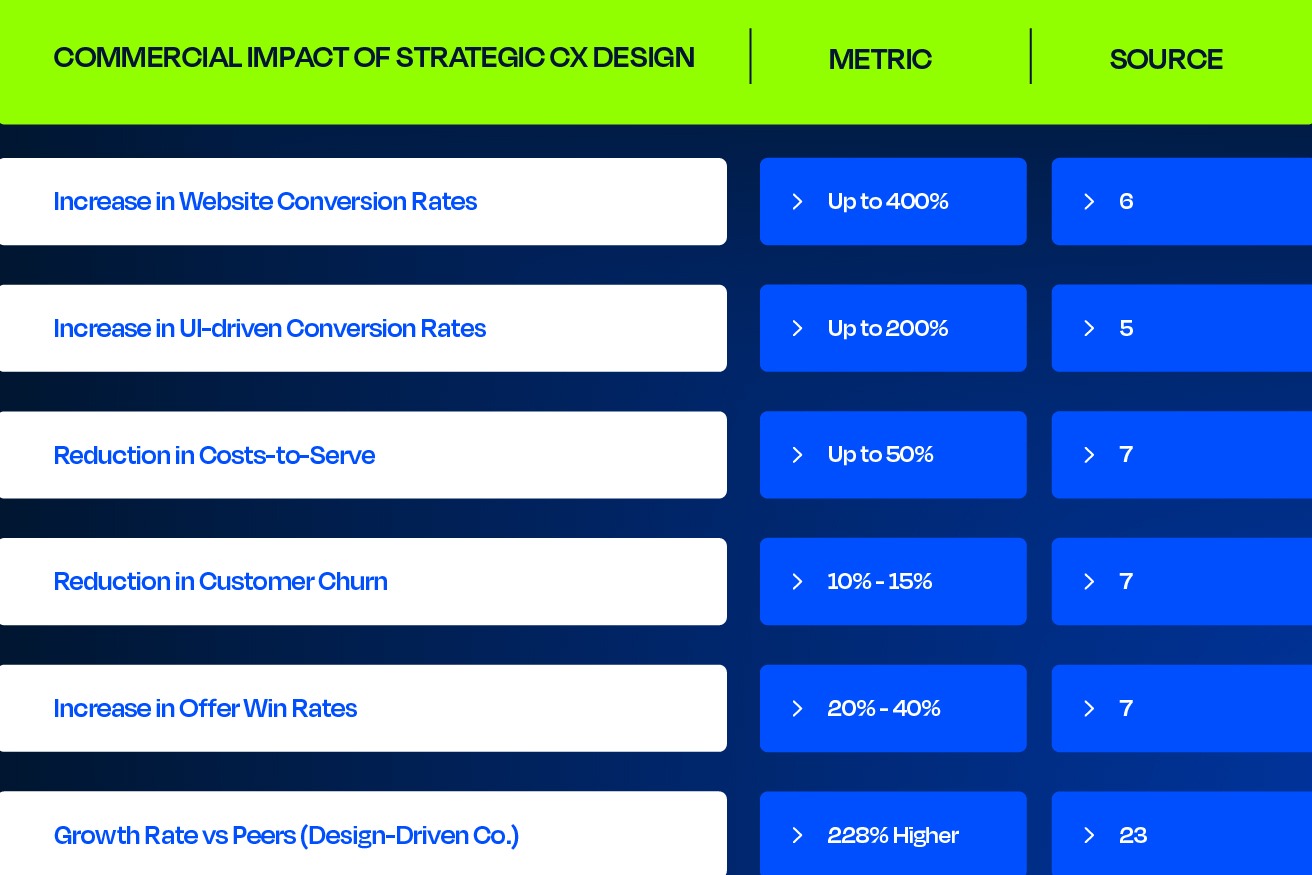
Usability testing raises website conversion rates by as much as 400%. Testing must be continuous; Already in 2016, Forrester’s research indicated that companies with mature research practices are 1.9 times more likely to report improved customer satisfaction.
Phase 6: Implementation and Optimization
The final phase involves accurate development and continuous performance monitoring.
CX design does not end at launch. High-performing B2B companies track metrics like Customer Effort Score (CES), Net Promoter Score (NPS), and Customer Satisfaction (CSAT) to identify areas for ongoing improvement.
CX or UX? What’s the difference?
If you’ve worked with user experience design, it’s easy to mix up UX and CX because they share a lot of principles.
The key difference is what they focus on. UX design usually looks at specific interactions with your brand, like completing a form on your website or uploading photos in your app.
CX design, instead, considers the full journey a customer has with you, from the ad they notice on social media to reaching out to support after an issue with their tenth order.
Comparing them point by point
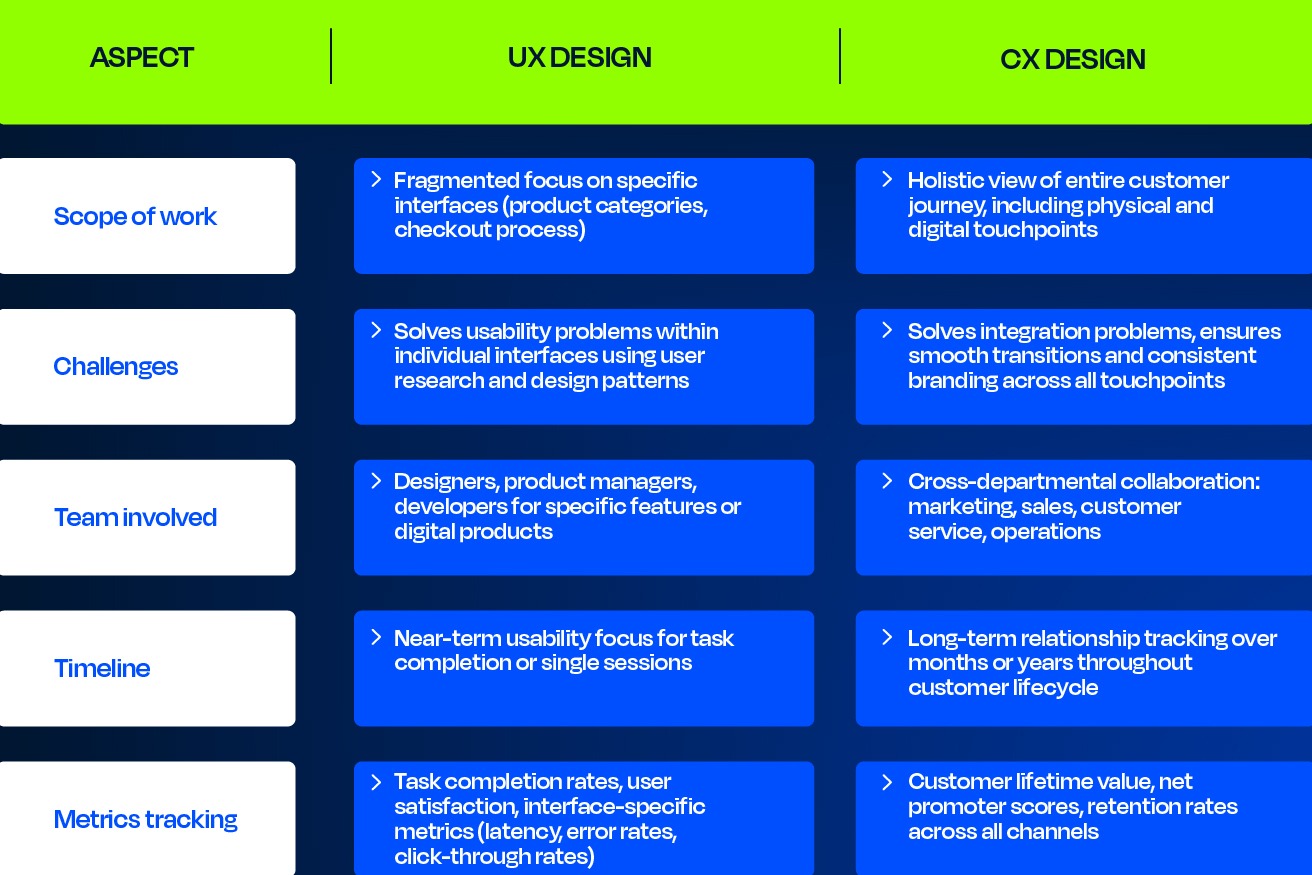
Scope of work. UX work is often limited to individual parts of a product or site. For example, browsing categories or going through checkout. CX design zooms out to connect every step, checking how each touchpoint affects the others and whether messaging and branding stay consistent. It also extends beyond digital, including physical locations and how they tie into online experiences.
Challenges. UX design aims to fix usability issues inside specific interfaces, using research and proven patterns. CX design tackles continuity and integration — making transitions between touchpoints feel natural and ensuring the experience doesn’t feel disjointed, like having a clean, minimal landing page while the rest of the site is crowded and confusing.
Team involved. UX design usually brings together designers, product managers, and developers working on defined features or digital products. CX design needs broader alignment across the business — marketing, sales, customer service, and operations — so the experience feels coherent and relevant at every stage.
Timeline. UX design tends to focus on short-term goals within a single task or session. CX design looks at the relationship over time, across months or years, and how customer expectations and perceptions change throughout their lifecycle.
Metrics tracking. UX success is commonly measured through task satisfaction, completion rates, and interface-level signals like load time, error rates, and click-through. CX design tracks broader, long-term indicators such as customer lifetime value, net promoter score, and retention across all channels.
Designing customer experience across many channels and touchpoints is complex, but the payoff makes it worth the effort.
B2B Customer Experience & User Testing Commercial ROI
The commercial justification for CX design is found in its ability to drive measurable business outcomes.
In a market where 71% of B2B buyers get frustrated when interactions are not personalized, design serves as the primary engine for personalization at scale.
Companies that prioritize CX see revenue gains of 5% to 10% and cost reductions of 15% to 25% within two to three years of implementation.
The ROI of evidence-based design
The financial impact of UX and CX design is documented across multiple authoritative studies.
Forrester has shown that an intentional, strategic UX design can increase conversion rates by 400%, and on average, every $1 invested in UX brings a return of $100.
Furthermore, B2B companies that successfully implement omnichannel strategies — providing consistent experiences across email, website, and sales interactions — are significantly more likely to grow their market share.
Strategic CX design also facilitates the adoption of emerging technologies. For instance, 75% of B2B companies have already adopted AI for lead scoring, resulting in a 25% improvement in lead quality.
By 2026, the integration of AI-powered conversations will become the standard for customer service, allowing organizations to scale their support without increasing headcount, provided the underlying experience is well-designed.
Synthesis and Recommendations for B2B Stakeholders
The convergence of digital-first buying habits, expanding stakeholder groups, and the rise of AI-driven research has made CX design an existential priority for B2B companies.
The fact that 50% of the market still does not conduct online user testing creates a significant opportunity for first-movers to differentiate themselves through superior service quality.
To capitalize on this shift, B2B companies from all sectors must move beyond "tactical marketing" and adopt a strategic design framework.
This requires a cultural transformation that empowers employees to see the world through the customer's eyes and redesigns internal functions to create value in a customer-centric way.
The financial rewards — an ROI of 9,900% and a 228% higher growth rate than peers — are reserved for those who treat customer experience not as a slogan, but as a rigorous business discipline.
By following the six-step design process, B2B companies can bridge the adoption gap and secure their position in the $36 trillion digital economy of 2026.
The mandate for 2026 and beyond is clear: optimize the experience, or be optimized out of the market.
Learn how to bridge the B2B experience gap with our comprehensive Customer Experience Discovery and proven UX/UI Best Practices that deliver 228% higher growth rates.