


Why 3D & CGI Competence Is Already a Competitive Advantage in B2B Marketing and Sales
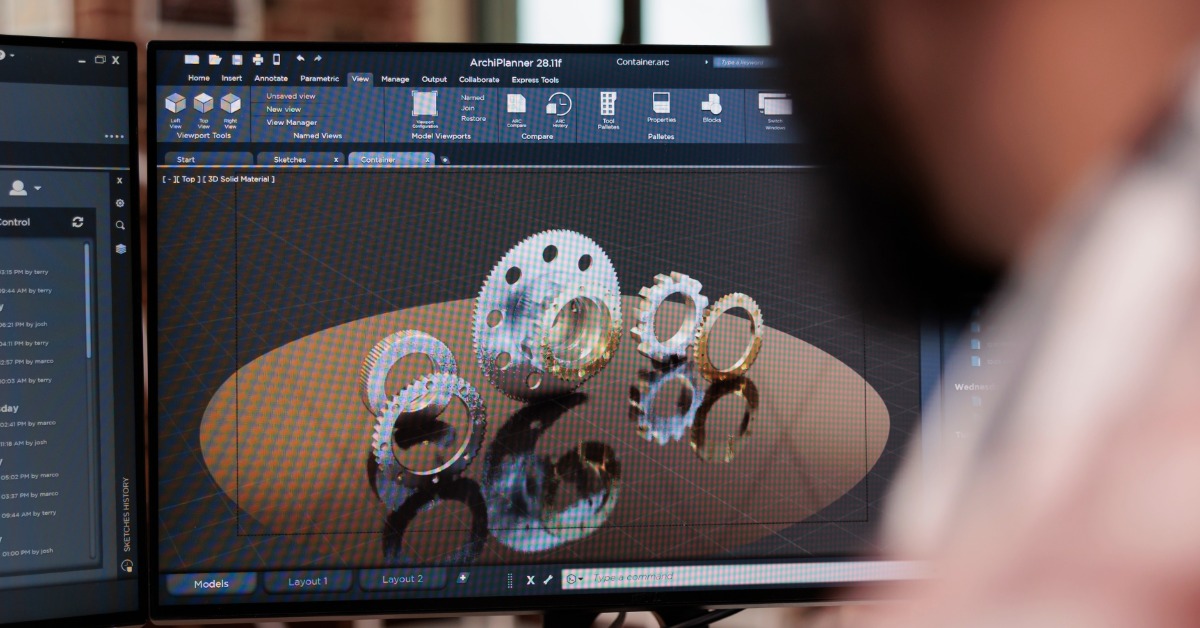
From CAD file to digital touchpoint: how 3D and CGI shorten the sales cycle and improve the customer experience
B2B sales cycles are getting longer. Buying groups are growing larger. Purchase decisions are becoming more complex. Yet the ability of most companies to explain what they sell has barely evolved, still relying on PDFs, technical datasheets, and product photographs that, in most cases, communicate only a fraction of what a customer needs to understand before buying.
This is the real problem. Not an aesthetic concern, not a creative trend, but a structural comprehension gap that slows down sales, multiplies late-stage objections, and makes every demo or on-site visit more expensive than it should be.
3D rendering, CGI (Computer-Generated Imagery), 3D animations, and interactive configurators are concrete answers to a commercial efficiency problem. And B2B companies that have recognized this are already shortening their sales cycles, reducing acquisition costs, and building competitive advantages that are difficult to replicate.
Why 3D & CGI Matters in B2B Right Now
The Explainability Gap: The Problem No PDF Can Solve
Modern industrial products — integrated machinery, custom-built systems, configurable production lines, high-engineering components — carry a growing complexity that traditional imagery simply cannot convey.
A static render of an eight-ton machine shows the external shape, but not the internal flow, not the interlocking of components, not the logic that justifies choosing that solution over a competitor's. A technical datasheet reaches the engineering manager, but not the CFO approving the budget, not the plant manager assessing operational impact, not the procurement officer comparing three vendors simultaneously.
The result is what communication professionals call the explainability gap: the distance between what a company knows about its product and what the buyer can actually understand from the available sales materials. This gap generates uncertainty, slows decision-making, and multiplies the technical meetings required before a contract is signed.
B2B 3D marketing — encompassing 3D renders, CGI animation, web configurators, and interactive viewers — is the structural response to this problem. A communication technology capable of making complex products immediately comprehensible to audiences who would otherwise need hours of explanation through conventional formats.
Visual Communication as Commercial Infrastructure
A 3D animation that breaks down a machine, shows its components in motion, visualizes internal flows, installation sequences, or differences from a previous generation does in seconds what a datasheet never will: it creates immediate, cross-functional understanding.
This matters particularly in B2B because buying groups are rarely homogeneous. The technical decision-maker, the financial approver, the operations lead, and the C-suite all have different needs, different vocabularies, and very different levels of tolerance for technical complexity.
A well-built 3D animation or CGI render speaks to all of them simultaneously, without diluting the message and without requiring the production of separate materials for each stakeholder.
The Data That Justifies the Investment
The evidence is clear. Product pages integrating interactive 3D models and exploratory viewers consistently show significantly higher conversion rates than those limited to static images. Buyers who engage with 3D product visualizations demonstrate measurably higher purchase intent, with a quantifiable reduction in pre-purchase uncertainty that translates into shorter decision cycles.
In B2B complex sales, the introduction of 3D assets in pre-sales phases correlates with reduced sales cycles and increased opportunity-to-order conversion rates. These are not theoretical projections, but they are documented outcomes across industrial, manufacturing, and technology sectors.
📌 Key Numbers: 3D in B2B Digital Marketing
- Product pages with interactive 3D viewer: conversion uplift up to +40% vs. static images
- Buyers using 3D configurators: estimated order error reduction of 20–40%
- Sales cycles for products supported by 3D demos: documented reductions of 20–30%
- CGI assets in B2B social campaigns: CTR up to 50% higher than traditional photography
What We Mean by "3D & CGI Competence" in a B2B Company
Commissioning a single 3D video for a trade show, ordering a render for a product launch, producing a CGI animation for the website: these are episodes. 3D & CGI Competence is something structurally different, and far more valuable.
Beyond the Single Render: A Continuous Capability
The difference between buying a one-off 3D video and building a genuine organizational 3D competence is comparable to the difference between purchasing a single press article and building an editorial team. In the first case, you get an output. In the second, you build a productive engine that generates outputs continuously, consistently, and at scale.
A structured 3D capability requires:
- Continuous collaboration between the engineering/product function (managing CAD files), marketing (defining communication needs), and sales (identifying friction in the buyer journey), supported by an external 3D/CGI partner with strong industrial domain knowledge.
- Systematic use of CAD data as the starting point: the 3D models already present in the company's PLM/CAD systems become the foundation for creating product virtual twins, from which animations, web configurators, AR/VR assets, photographic variants, and sales support materials are all generated.
- A centralized asset library: a structured repository of 3D models, scenes, materials, and animations that feeds all touchpoints consistently, without starting from scratch for every new project.
The digital twin — the virtual replica of the physical product — it is the foundation from which an entire scalable visual communication ecosystem can be built.
Components of 3D & CGI Competence
A mature B2B 3D competence operates across three interdependent levels:
People: The right people, internal and external
Internally, you need individuals capable of interfacing productively with the 3D partner: someone who manages CAD files, someone who translates commercial needs into creative briefs, someone who validates outputs against technical and brand standards. Externally, the ideal partner is a team with specific experience in industrial and technical contexts, capable of interpreting product complexity and translating it into content that works for diverse audiences.
Process: A documented and repeatable pipeline
A clear pipeline, from data source (CAD, technical specifications, existing photography) to marketing-ready asset, through to channel-specific deliverables: website, social campaigns, trade shows, customer portals, configurators, AR/VR. Each phase has defined ownership, predictable timelines, and documented quality standards. Without a pipeline, 3D competence cannot scale.
Asset: A library that grows over time
The end result is a structured library of 3D models, scenes, materials, and animations. Not a disorganized archive, but an organized resource that grows progressively richer, reducing the marginal cost of each new deliverable and accelerating the ability to respond to new market or communication requirements.
Impact Across the Key Digital Touchpoints of the B2B Buyer Journey
Where, concretely, does 3D enter the B2B buyer journey? In far more places than most companies realize, with measurable impact on engagement, comprehension, and conversion.
Website and Product Landing Pages
The most immediate touchpoint — and often the most underestimated — is the product page of the company website.
Today it is possible to integrate embedded 3D viewers that allow visitors to explore the product directly in the browser, without plugins: rotating it, cross-sectioning it, zooming in on specific components, triggering operational animations. We are talking about a stable, production-ready functionality, compatible with all major CMS platforms, powered by standards like WebGL, Three.js, and formats such as GLTF/GLB.
Take a look at how we redesigned the product pages of Prometheus — a company specialising in the manufacturing of fire protection systems and devices — through 3D animations and an interactive configurator that simulates the installation of products on real industrial actuators, turning the website from a simple showcase into a technical tool that supports informed purchasing decisions.
👉 Explore Prometheus case study.
Alongside the interactive viewer, a 3D animation explainer transforms the product page into a 24/7 comprehension tool. A 60–90 second video that deconstructs a machine, visualizes internal flows, identifies differentiation points versus competitive solutions, works in any language, requires no commercial technician present, and answers the buyer's questions at the precise moment they're forming them.
The impact on engagement and conversion is well-documented: increased time on page, greater scroll depth, reduced bounce rate, improved value proposition comprehension. A buyer who has "explored" your product in 3D arrives at the sales call with significantly higher understanding — and concrete interest — than one who has only read the technical sheet.
Customer Portals, Configurators, and Self-Service Interfaces
For modular, configurable, or high-variability products, web 3D configurators represent one of the highest-ROI investments available in B2B marketing today.
The principle is simple in logic, sophisticated in execution: the customer selects dimensions, materials, optional components, and the configurator displays the configured variant in 3D in real time. Not a 2D technical diagram, not a variant table, a photorealistic visualization of the final product in the chosen configuration.
The operational benefits are multiple:
- Order accuracy: the customer sees exactly what they are purchasing, significantly reducing configuration errors and costly post-order rework.
- Buyer autonomy in the evaluation process: customers can explore variants and combinations independently, accelerating the evaluation and pre-selection phase without consuming sales team bandwidth.
- Automated quoting support: 3D configurators can be integrated with pricing logic, generating draft proposals directly from the interface and reducing the sales team's workload in early-stage conversations.
- AR/VR bridge: the same 3D models used in the web configurator can be made available in augmented reality, allowing customers to "place" the machine virtually in their facility before purchase, further reducing perceived risk.
Sales Enablement and Remote Demos
One of the most significant structural shifts in B2B sales in recent years is the normalization of remote demos. Customers expect a Teams or Google Meet call to substitute, at least in initial stages, for a physical visit. The problem is that most B2B companies are still conducting these calls with the same PowerPoint slides they used five years ago.
3D virtual showrooms change this dynamic entirely. A Sales Rep. who opens a shared session with a navigable 3D model of the product — rotating it, cross-sectioning it, isolating key components, animating process flows in real time during the call — is literally bringing the product into the customer's room.
The operational impact is measurable:
- Reduction of physical pre-sales visits, with consequent reduction of travel costs and optimization of technical sales team schedules.
- Better lead qualification at early stages: customers who have "seen" the product in 3D arrive at subsequent meetings with specific, high-intent questions, exactly the kind of questions that accelerate closing.
- Common language across heterogeneous audiences: the 3D model functions as a lingua franca between the non-technical buyer, the engineering lead, and the C-suite, facilitating internal consensus building without requiring separate sessions for different stakeholders.
Content for Social Media, Campaigns, and Trade Shows
3D doesn't only live on the website or in demos. Once the asset library is built, the same base model can be deployed across a full range of operational formats:
- Hero content for LinkedIn Ads and Programmatic campaigns: high-impact CGI animated videos that stand out sharply from the static content mass in feed, with documented engagement performance significantly above industry benchmarks.
- Trade show booths and large-format displays: high-resolution visual loops that explain the product in 30–60 seconds, substituting or complementing the physical presence of technical sales staff at events.
- Channel-specific variants: 15, 30, and 60-second cutdowns, vertical formats for social, animated sequences for display campaigns, all generated from the same base model, with no need for additional physical shoots.
- Hybrid event content: animated presentations, virtual backgrounds, assets for technical webinars.
This point is frequently underestimated: the 3D library becomes a source of operational daily marketing content that compounds in value over time.
✅ Checklist — Is 3D Already Present in Your Buyer Journey?
- Do your product pages have an interactive 3D viewer or 3D animation?
- Do your sales reps use 3D assets in remote demos?
- For modular products, does a visual configurator exist for customers?
- At events/trade shows, are 3D CGI videos used on screens or interactive booths?
- Do your social and paid campaigns include CGI assets — or only traditional photography?
- Is there a centralized 3D asset library shared between marketing and sales?
Business Benefits Across the B2B Funnel
Mapping the benefits of 3D & CGI across the B2B sales funnel helps build the internal business case and reach commercial efficiency and measurable revenue impact.
Top of Funnel — Attention and Differentiation
In a market where the vast majority of B2B competitors communicate through white papers, datasheets, text banners, and conventional product photography, a high-quality 3D animation or CGI render creates immediate scroll-stop and superior memorability.
Visual differentiation is not merely about "looking good": it is a brand signal. A company that communicates the technological complexity of its product using visually advanced tools implicitly conveys a perception of innovation and reliability consistent with the product itself. The gap between the technological quality of what you sell and the visual quality of how you communicate it is a real credibility cost, often unnoticed internally, but clearly registered by the buyer.
Middle of Funnel — Comprehension and Trust
In the evaluation phase, the buyer is comparing solutions, building the internal business case, and involving stakeholders with diverse backgrounds. CGI becomes here an instrument of accelerated comprehension.
An animation demonstrating how a specific component works, visualizing its advantages over a previous solution, or visually answering the most frequently asked technical questions can be shared by the sales rep between meetings as on-demand content. It doesn't replace the commercial conversation, but it prepares and qualifies it. The buyer arrives at the next meeting already oriented, with fewer foundational doubts and more specific, high-intent questions. Exactly the type of questions that move deals toward close.
Bottom of Funnel — Sales Cycle Acceleration
At the decision-making stage, 3D & CGI operates through two precise mechanisms:
Uncertainty reduction: buyers who have "seen" the product in 3D, explored its configurations, and understood its internal mechanics arrive at the decision with significantly fewer residual doubts. Uncertainty is the primary inhibitor of closing in B2B complex sales, every source of visual clarity is directly proportional to decisional velocity.
Buying group alignment: sales cycle delays in B2B often originate not with the primary buyer but from the need to obtain consensus from secondary stakeholders, CFO, technical lead, management. A shareable, independently explorable 3D model acts as an accelerator of internal consensus building, reducing the need for additional alignment meetings.
Post-Sale and Training
The value of 3D doesn't end with contract signature. The same animations and 3D models produced for pre-sales can be repurposed — often at minimal additional investment — for:
- Operator training: complex procedures, assembly sequences, safety protocols,, all visualizable in 3D consistently and scalably, regardless of language or geographic location.
- Maintenance and troubleshooting: animations that demonstrate correct intervention procedures, reducing technical support calls and improving the quality of autonomous maintenance interventions.
- Up-sell and cross-sell enablement: visualizing an add-on module, a configuration upgrade, or a complementary system in 3D is far more effective than a text description. It reactivates the purchase cycle with high perceived-value content.
When 3D & CGI Investment Is Truly Justified (and When It Isn't)
The question is not "does 3D work?" The answer is yes, under the right conditions. The correct question is: when is the investment a clear priority over competing alternatives?
Conditions That Make 3D a Priority
✅ Complex or difficult-to-photograph products: integrated machinery, systems with non-visible internal components, fluid or energy processes, production lines, all situations where traditional photography fails to capture the real value proposition and technical datasheets don't reach non-technical decision-makers.
✅ High configurability: when product variants are numerous — dimensions, materials, options, custom configurations, a 3D configurator is the most efficient tool for managing communicative complexity, reducing order errors, and qualifying buyers before the first direct commercial contact.
✅ International and multilingual markets: 3D visual content speaks a universal language. The same asset can be linguistically localized (voice over, subtitles, overlay text) while keeping the visual component unchanged, delivering production efficiency significantly superior to creating separate materials for each market.
✅ Pre-production product launch: creating marketing materials before the physical prototype exists is one of the most strategically powerful CGI applications. It enables campaign launches, market feedback collection, pre-selling, and backlog generation, compressing time-to-market and extracting value from every phase of product development.
✅ High-value or high-margin products: 3D investment ROI correlates directly with the economic value of the product being communicated. Products whose price justifies long sales cycles and complex decisions are precisely those where CGI generates the most evident return.
For Arox, whose flagship product is a high-performance chip, the challenge was how to represent the architecture and design of the microcontroller — especially at pre-launch stage. In building the new corporate website (recent winner of an Awwward), 3D renderings of the chip proved to be an essential tool: not just for aesthetic reasons, but to communicate the technical complexity of the product in an immediate and compelling way.
👉 Explore Arox case study.
When It Doesn't (Yet) Make Sense
- Simple, low-complexity products for which quality photography and a clear datasheet are sufficient and effective.
- Budgets too limited to sustain a continuous pipeline: better one or two strategically positioned, high-quality assets than a series of mediocre renders that communicate the wrong message about your brand.
- Organizations that haven't yet resolved foundational communication problems: unclear value proposition messaging, poor site architecture, obsolete sales materials. 3D amplifies what's there, it doesn't fix what's missing.
📌 Is Now the Right Time to Invest in 3D & CGI? Answer these questions:
- Is your product or system difficult to explain with a standard photograph?
- Do you have many product variants or high configurability?
- Do you sell across multiple markets or languages?
- Does your typical sales cycle exceed 60 days?
- Do your sales reps conduct remote demos regularly?
- Are you preparing to launch a new product without a physical prototype yet?
If you answered yes to at least 3 of these, 3D & CGI is already a strategic priority for your B2B company.
How to Build (or Engage) 3D & CGI Competence
From awareness to concrete roadmap. Where to actually start?
Start With What Already Exists: CAD, PLM, Internal Knowledge
The first step is not to call a 3D studio. It's to understand what already exists in the organization.
Most industrial and manufacturing companies already have updated CAD models of their products, created for engineering purposes and never leveraged for marketing. These models are often an excellent starting point for marketing-ready 3D asset production, the incremental work required to transform a CAD file into a renderable model is significantly lower than modeling from scratch.
The first concrete action is to map: which products have updated CAD files, who manages them, at what level of detail, and how they can be securely shared with an external partner.
From this mapping, you identify the 2–3 strategic product families to start with: those with the highest revenue, the strongest cross-sell potential, or those for which today's sales cycle is longest, most complex, and most expensive.
Choosing the Right Partner and Defining the Pipeline
The ideal digital partner for industrial B2B is not the one with the most creative or visually polished portfolio. It is the one that:
- Has experience in industrial and technical sectors and can interpret a complex CAD file without weeks of briefing.
- Speaks the language of the product: understands the difference between a structural and an aesthetic component, knows what needs to be visible and what doesn't in an explainer, knows where to concentrate rendering quality for maximum communication effect.
- Builds efficient pipelines with documented output standards: delivery formats, light and material presets, stylistic guidelines ensuring cross-channel and cross-campaign consistency.
- Can support not only individual deliverables but the progressive construction of a reusable asset library, with organization and reuse logic that reduces marginal cost over time.
Once the partner is selected, you define the pipeline together: from CAD delivery format standards, to photorealistic rendering standards, to style guidelines that guarantee coherence across all touchpoints.
Integrating 3D & CGI Into Existing Marketing and Sales Processes
The most common mistake is treating 3D as an "additional layer" inserted downstream of existing processes. The result: an asset produced late, misaligned with real needs, difficult to integrate into digital tools, and never truly adopted by the sales team.
3D must be integrated upstream:
- In website development briefs: the 3D viewer as a native component of the product page, not an element added as an afterthought.
- In campaign planning: CGI animation as a planned format from the outset, not a fallback when photography proves insufficient.
- In product launch processes: CGI as a pre-launch instrument, not post-production documentation.
On the infrastructure side, 3D assets must be connected to existing digital tools: website CMS, marketing automation platforms, sales enablement platforms, customer portals. A 3D asset that exists only in a shared folder is not a competence, it is just a file. Value emerges when the asset is accessible, activatable, and trackable across all relevant touchpoints.
Frequently Asked Questions
Starting from scratch, how much does it take to get started?
A large initial investment is not required. By identifying 2–3 priority products and starting from existing CAD files, it is possible to produce meaningful first assets at a contained investment, measure the return, and scale progressively from there.
Do we need an internal technical team to manage CAD models?
No. An experienced industrial 3D partner can work directly with CAD files received from the engineering team without requiring specific technical expertise from the marketing side. The key is defining a clear handoff process between the two functions.
Does 3D content replace traditional photography?
Not necessarily, the two modalities are often complementary. 3D is particularly effective for complex, configurable, or not-yet-physically-existing products. Traditional photography remains valid for simple products or when the real environmental context is an integral part of the message.
How long does it take to produce the first asset?
It depends on product complexity and the quality of available CAD source files. A medium-complexity animation typically requires 4–8 weeks from material receipt to master delivery.
Can the same 3D models be reused across different channels?
Yes, and this is one of the core advantages of a structured 3D competence. A single base model can generate: interactive web viewer, social campaign animation, trade show cutdowns, AR/VR assets, static catalog imagery. The production cost of each derivative is marginal relative to the original model investment.
🎯 Ready to Integrate 3D & CGI Into Your Marketing Strategy?
At Krein, we partner with B2B companies to build structured 3D & CGI competence: from mapping existing CAD assets to producing marketing-ready deliverables, from web configurators to high-impact CGI social campaigns.