


Is Your Data Training Someone Else's AI? What Data Sovereignty Means for B2B

Data sovereignty is control over who can access a company's data, on what terms and under which law. Artificial intelligence changes its nature: data is no longer just something to safeguard, it feeds model training and outputs. For a B2B company this means reviewing cloud and SaaS contracts, rules for using AI and data sharing along the supply chain, in light of the Data Act, the AI Act and the proposed EU Cloud and AI Development Act.
Why has data sovereignty become a business issue?
For years the question was “where is my data?”. With artificial intelligence it has become “who can use it, under which law, and to train what?”. Data sovereignty is no longer a topic for lawyers and IT managers alone. It concerns the value of industrial data, operational continuity and a company's freedom to choose its technology suppliers.
The signals are coming from every direction. In a Capgemini Research Institute survey of 1,300 executives, 93% of organisations had discussed it at board level, and three in four named AI as the part of the tech stack where sovereignty matters most. Gartner expects worldwide spending on sovereign cloud infrastructure to reach $80 billion in 2026, up 35.6% on 2025. Meanwhile the European Union has made the Data Act applicable and proposed a dedicated law on cloud and AI with certified sovereignty levels.
What is data sovereignty, and how does it differ from data residency and data protection?
There is no single definition. A review in Big Data & Society by Hummel, Braun, Tretter and Dabrock analysed 341 publications and found divergent, sometimes unclear meanings. A study by Oxford and Bologna researchers in Internet Policy Review likewise notes that EU documents use the concept inconsistently.
For a business, it helps to think in three layers, from the broadest to the most operational:
- Digital sovereignty. For the European Parliamentary Research Service, it is Europe's ability to act independently in the digital world. The Commission's first policy brief on the topic, published in 2026, describes it as strategic independence that remains open and connected to global networks.
- Data sovereignty. Control over who accesses data, on what terms and under which jurisdiction. The International Data Spaces Association, born around Fraunhofer, defines it as the ability to decide for oneself how, when and at what price others may use one's data across the value chain.
- AI sovereignty. Control over the whole AI chain: infrastructure, models, applications and rules of use. As McKinsey analysts put it, you can have sovereignty over your data without having it over the AI that processes it.
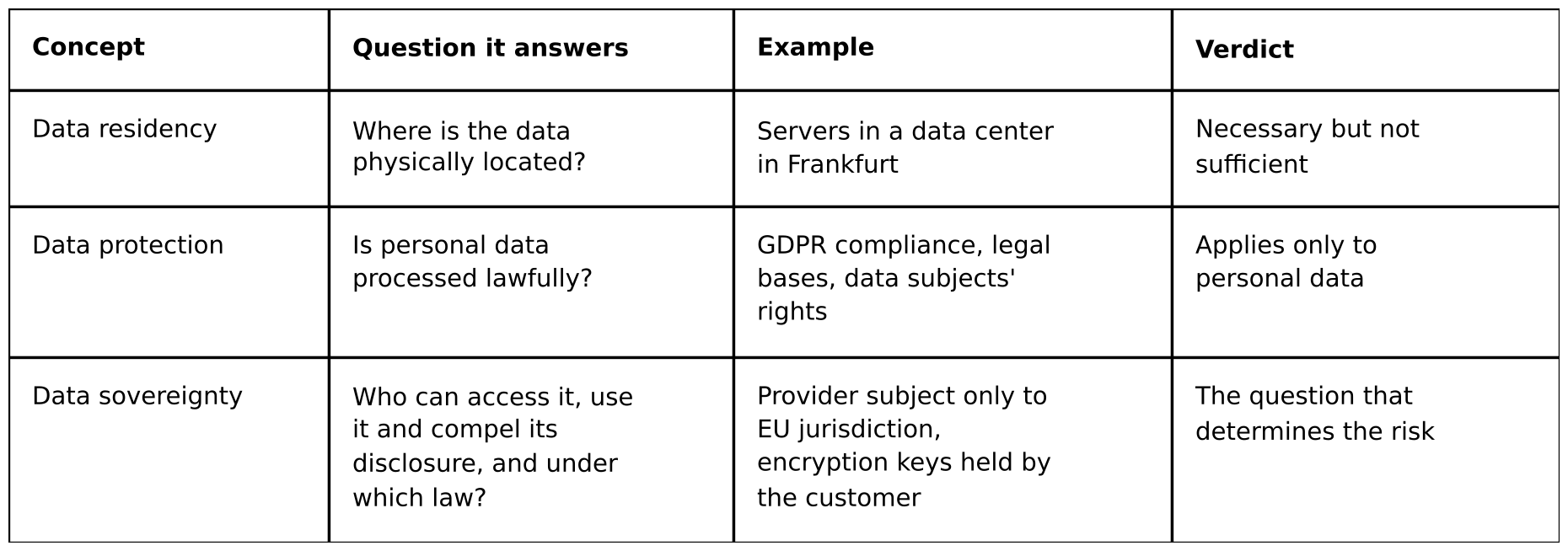
Data can reside in Europe and be processed in line with the GDPR, yet remain exposed to third-country laws if the provider managing it is subject to them. And sovereignty is not only about personal data: for an industrial company, production data, technical designs, machine data and trade secrets matter just as much.
In a report on sovereign AI, McKinsey suggests reading it as a spectrum rather than a binary state, along four dimensions: territorial, operational, technological and legal.
Why does AI make data sovereignty more urgent?
In traditional cloud computing, data was an asset to be safeguarded. With AI it also becomes raw material: it feeds training, fine-tuning and model outputs. The risk moves to three points in the chain.
Training. A company's data can end up, directly or indirectly, improving models that also serve its competitors. It is no accident that, for its higher sovereignty levels, the European proposal on cloud and AI provides for an independent audit that also checks whether data generated by the provider may be used to train or fine-tune AI models, as law firm Wilson Sonsini summarises. On the other side, since 2 August 2025 the AI Act has required providers of general-purpose models to publish a summary of their training content using a Commission template.
Inference. Every prompt, uploaded document or integration with an AI assistant sends information to an external infrastructure. With AI agents that read and write in company systems, the exposure grows further: it is no longer a stored file but ongoing access to CRM, ERP and technical documentation.
Dependency. Models and computing power are concentrated in a few hands. The Draghi report notes that around 70% of foundation models developed since 2017 come from the United States. Citing Stanford's AI Index, McKinsey reports AI investment of $300 billion in the US between 2020 and 2024, against $62 billion in Europe.
Adopting AI without a data policy means implicitly deciding who will capture the value. Adopting it with a clear policy means being able to use it more, not less.
Which EU rules define data sovereignty?
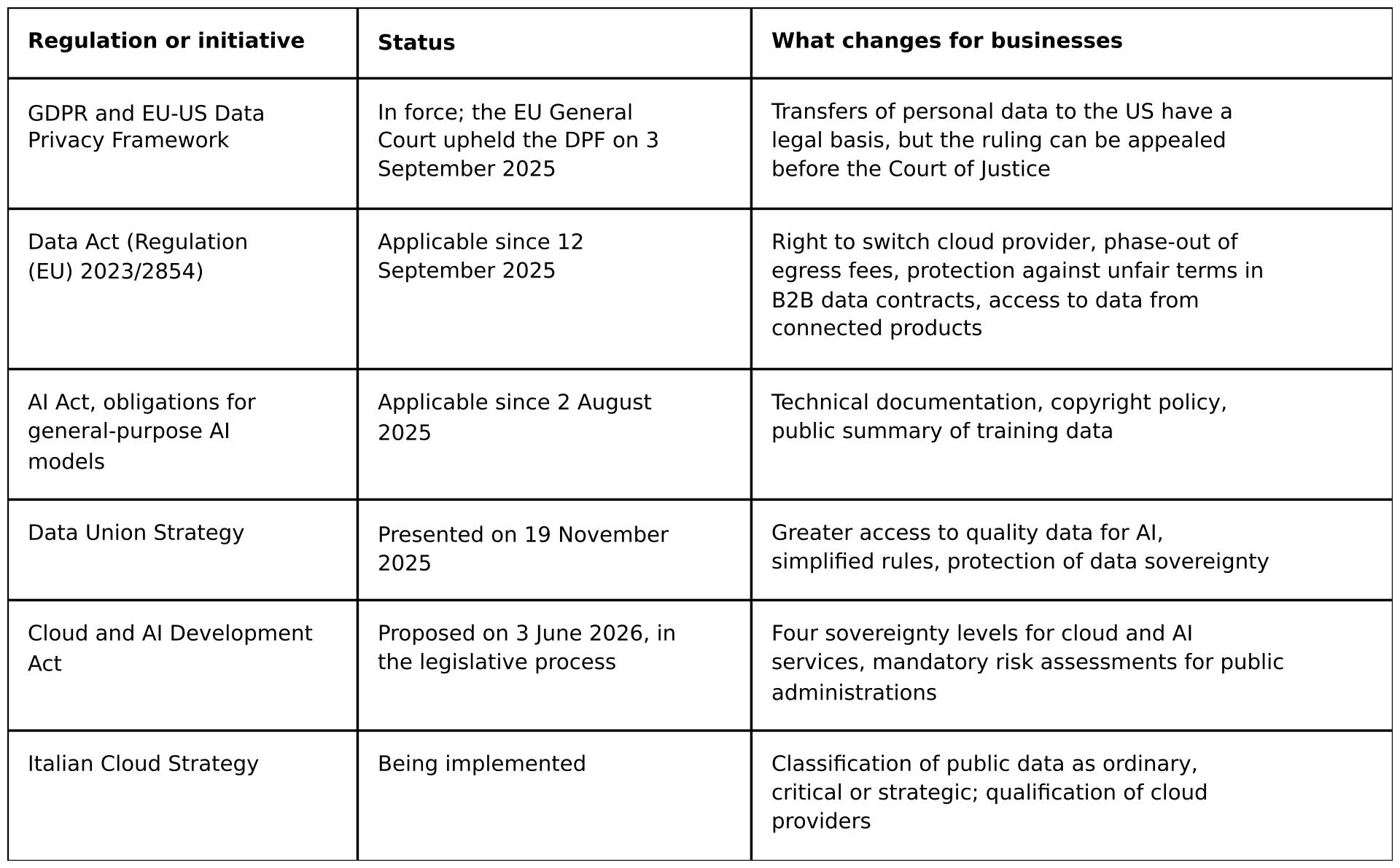
Europe has built data sovereignty layer by layer: first personal data protection, then industrial data sharing, then AI, and now cloud. For a B2B company these layers add up.
What does the Data Act change for B2B companies?
The Data Act is the rule closest to B2B. According to Norton Rose Fulbright, the provider-switching and portability rules have applied since 12 September 2025. Protection against unfair terms applies to new contracts, while existing long-term contracts must be brought into line by 12 September 2027. Simplified data access covers connected products placed on the market after 12 September 2026.
On cloud, DLA Piper points out that from 12 January 2027 providers can no longer charge switching fees. The Data Act also requires providers to take reasonable measures, such as encryption and audits, against access to non-personal data by third-country authorities, as Lewis Silkin summarises.
What does the Cloud and AI Development Act propose?
The proposal presented on 3 June 2026 introduces an EU framework with four assurance levels. As Jones Day describes it, these range from level 1, which requires processing and storage on EU infrastructure, to level 4, which requires full transparency and control over the software supply chain with no third-country interference. According to Taylor Wessing, public authorities and critical infrastructure operators will have to carry out a sovereignty risk assessment before using a cloud or AI service.
The law is aimed mainly at the public sector. But according to Agence Europe, Executive Vice-President Henna Virkkunen recommended that companies in sectors covered by the NIS2 Directive do the same. For many industrial, energy and manufacturing firms, sovereignty levels will soon appear in tender specifications and customer requirements.
How does Italy classify public data?
Italy moved early on the public sector. The Cloud Strategy for Italy, developed with the National Cybersecurity Agency (ACN), classifies public data and services as ordinary, critical or strategic according to the damage their compromise would cause the country, as Agenda Digitale explains. Since January 2024, qualification of cloud services for public administrations has moved from the Agency for Digital Italy (AgID) to ACN, according to LineaEDP. For B2B suppliers that also work with the public sector, the same classification logic is a good starting point for their own data.
Why isn't a data centre in Europe enough?
How dependent is Europe on non-EU cloud providers?
The European cloud market is highly concentrated. The Draghi report on European competitiveness estimates that three hyperscalers hold over 65% of the market. The explanatory memorandum to the Cloud and AI Development Act, filed with the Council of the EU, states that EU providers' share fell from 29% in 2017 to 15% in 2022, and that three non-EU hyperscalers control over 70% of the European market. The EU Institute for Security Studies also reads this concentration as a structural dependency that puts the confidentiality of European data at risk.
What does the US CLOUD Act have to do with it?
The issue is not the providers' nationality as such, but the law they answer to. The US CLOUD Act of 2018 allows US authorities to obtain data controlled by US companies even when it is stored abroad. On 10 June 2025, at a French Senate hearing, Microsoft France's director of public and legal affairs stated under oath that he could not guarantee that French citizens' data would never be passed to US authorities without French consent, while adding that it had never happened, as The Register reports.
The case shows the limits of data residency alone. Yet the picture is not black and white: the EU–US Data Privacy Framework has been upheld by the EU General Court, and most companies will keep using global services for many activities. The right question is not “fully sovereign or nothing”, but “which data and which processes need which level of control”.
How big is the market for sovereign cloud and sovereign AI?
Gartner calls the shift of workloads to national or regional environments “geopatriation” and expects it to move 20% of current workloads from global to local cloud providers. According to figures reported by ITPro, European sovereign cloud spending will rise from $6.9 billion to $12.6 billion between 2025 and 2026, overtaking North America in 2027. Gartner notes that around 80% of this spending will go to new initiatives or systems not yet migrated.
According to McKinsey, 30–40% of AI spending could be influenced by sovereignty requirements. In a separate analysis the firm estimates a sovereign AI market of $600 billion by 2030, driven by the public sector and regulated industries, and reports that 71% of the 300 executives surveyed see it as an existential concern or a strategic imperative.
Companies, however, are pragmatic. According to the Capgemini Research Institute, 59% see full digital sovereignty as unrealistic, and two thirds define it as “resilient interdependence”: selective control over critical technologies, partnerships for the rest. Only 14% report end-to-end visibility into their technology dependencies.
What does data sovereignty mean in B2B?
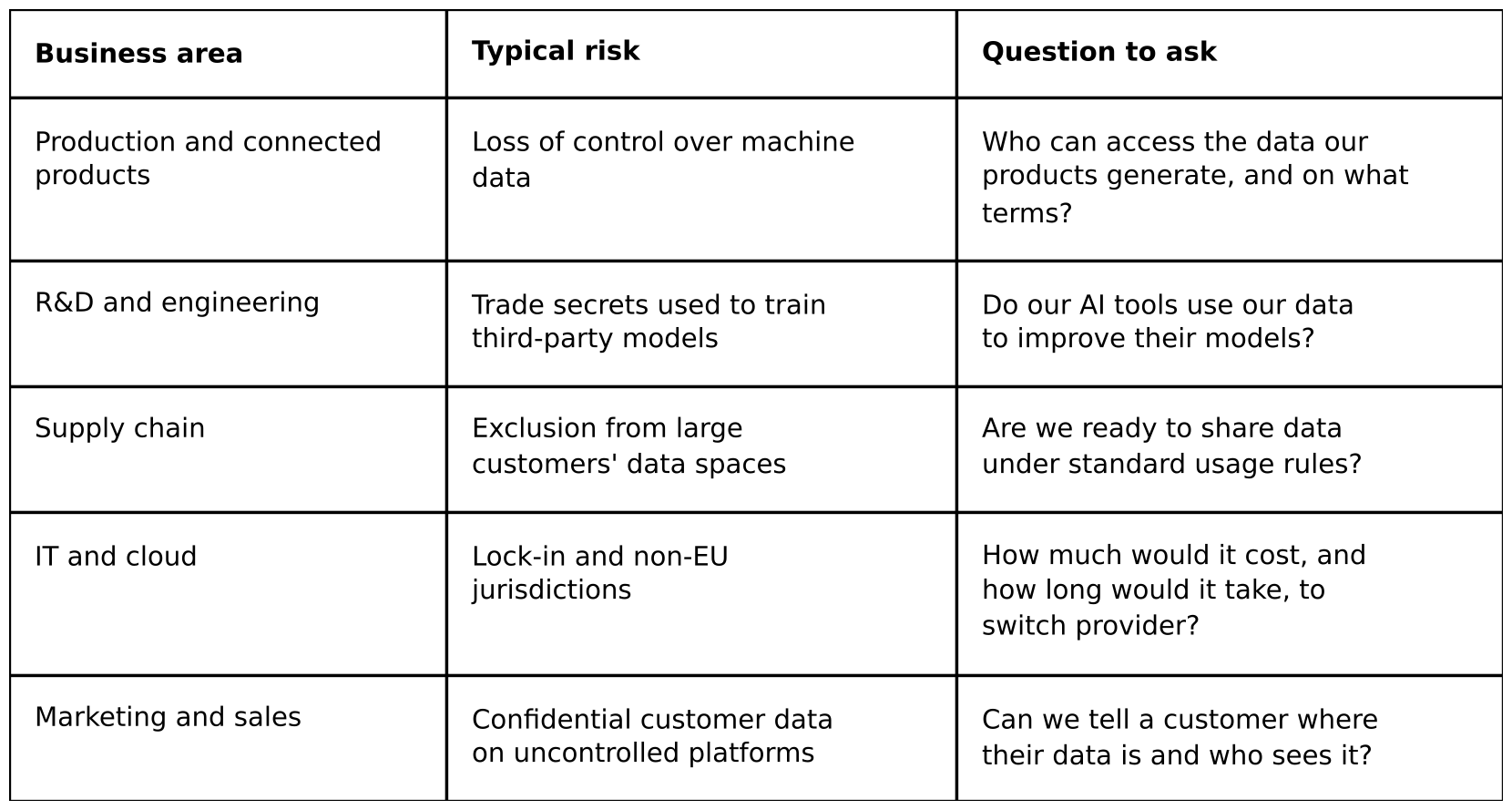
In B2C, data sovereignty is mostly a privacy issue. In B2B it is a matter of value, of bargaining power along the supply chain and of commercial trust.
Who controls the data generated by machines and connected products?
For a machine builder, a component maker or an energy company, the data generated by plants and connected products is worth as much as the product itself. The Data Act gives users of connected products the right to access this data and share it with third parties, and requires manufacturers to design for access from the outset for products placed on the market after September 2026. According to PwC Legal, data holders may however charge reasonable compensation for B2B data sharing, opening the door to new licensing models. Those who sell machines must rethink contracts, platforms and after-sales services; those who buy them gain new bargaining power over the data they generate.
How can data be shared along the supply chain without losing control?
Europe's answer is data spaces. The European technology industry association Orgalim describes them as decentralised, federated systems in which data holders keep control, while interoperability, trusted identities and usage policies make exchange possible. In the International Data Spaces Association model, the data owner attaches usage conditions to the data before transferring it.
In automotive, this approach has taken shape in Catena-X. Fraunhofer describes how sector data spaces such as Factory-X are emerging on this basis, within the Manufacturing-X initiative backed by the German government. For an SME in the supply chain, joining these ecosystems will increasingly become a condition for working with large customers.
Why is data sovereignty entering tender specifications?
With the Cloud and AI Development Act, sovereignty levels will become purchasing criteria for public bodies and, by knock-on effect, for critical infrastructure and its supply chains. A supplier that cannot say which infrastructure its service runs on, who can access the data and which AI processes it risks being screened out before it even submits a bid.
What changes for Marketing and Sales?
CRM, marketing automation, intent data tools and AI assistants handle information about customers, prospects and deals. In B2B that data often includes customers' projects, volumes and commercial terms, information the customer considers confidential. Using it to train external models or sharing it with third-party platforms without clear rules is a legal and reputational risk. At the same time, a company that can explain simply and verifiably where customer data sits, who accesses it and how AI uses it builds trust.
How do you build a tiered data sovereignty strategy?
Sovereignty is not an on/off switch. McKinsey describes it as a spectrum, the European proposal breaks it into four levels, and the Cloud Strategy for Italy classifies data by the impact of its compromise. A B2B company can apply the same logic in six steps.
- Classify your data into at least three classes, following the Italian model: ordinary, critical, strategic.
- Map your dependencies: cloud, SaaS and AI suppliers, the jurisdictions they answer to and the data they handle. According to Capgemini, only 14% of organisations have full visibility into their dependencies.
- Assign a level of control to each class: EU residency for ordinary data; a provider subject only to EU law, or internally managed encryption keys, for critical data; dedicated or on-premise infrastructure for strategic data.
- Review your contracts: exit and portability rights as provided by the Data Act, an explicit ban on using your data to train models, location, audits, notification of access requests from authorities.
- Govern the use of AI: which tools are approved, with which data, under which settings. AI assistants and agents should be treated as suppliers that see confidential data.
- Prepare an exit plan: know how long and how much it would take to change provider. Capgemini finds that only 42% of organisations that recently suffered disruptions have a contingency plan.
Quick checklist
- ☐ Do we know where our critical data resides and which law applies to the provider managing it?
- ☐ Do our cloud and SaaS contracts rule out using our data to train models?
- ☐ Do we have a policy on using generative AI tools with customer and project data?
- ☐ Do we know our obligations and rights as makers or users of connected products under the Data Act?
- ☐ Can we clearly answer a customer who asks where their data is?
- ☐ Have we considered joining our supply chain's data spaces?
- ☐ Do we know what switching cloud provider would cost, in time and money?
What to do next
If you are starting from scratch, three low-cost moves come first. Classify company data into three levels and identify what is strategic. Take an inventory of the AI tools already used across departments, including those adopted without going through IT. Re-read your main cloud and SaaS contracts for clauses on exit, portability and the use of data for training.
If you already have an AI strategy, you can turn sovereignty into a commercial argument: a clear page on where customer data sits, who accesses it and how AI uses it, consistent with what your salespeople say. To adopt AI with clear data rules, Krein offers an AI implementation and agentic AI service, and a B2B digital strategy to set positioning and channels.
If you need to work out which data and processes require which level of control before extending your use of AI, talk to Krein.
FAQ
What does data sovereignty mean?
Data sovereignty is control over who can access data, use it or compel its disclosure, and under which jurisdiction. It is not the same as data residency, which only concerns where data is stored, or as the personal data protection required by the GDPR.
If data is stored in a European data centre, is it automatically sovereign?
No. If the provider operating the data centre is subject to third-country laws, such as the US CLOUD Act, that country's authorities may request access to the data even if it is stored in Europe. That is why the provider's jurisdiction, management of encryption keys and contract terms matter.
What is the difference between data sovereignty and sovereign AI?
Data sovereignty concerns control over data. Sovereign AI concerns control over the whole AI chain: infrastructure, models, applications and rules of use. A company can keep its data under control and still use AI models and services over which it has no influence.
Does the Data Act apply to B2B SMEs?
Yes, if they make or use connected products, share data with other businesses or use cloud services. The cloud switching and portability rules have applied since 12 September 2025, and from 12 January 2027 providers can no longer charge switching fees. For connected products placed on the market after 12 September 2026, data access must be built in by design.
Will the Cloud and AI Development Act force private companies to use European clouds?
The proposal of 3 June 2026 mainly concerns public administrations and critical infrastructure operators, which will have to assess sovereignty risk before using cloud and AI services. It is still going through the legislative process. For private companies the main effect will be indirect, through the tender specifications and requirements of public and critical customers.
How can you stop your data being used to train third-party models?
With three levers: contract clauses that explicitly prohibit using your data for training, AI tool settings checked by IT, and an internal policy on which data can go into which tools. For strategic data, consider solutions hosted on dedicated infrastructure.
Sources
- European Parliament, EPRS, Digital sovereignty for Europe, 2020.
- European Commission, Open but Not Powerless: Towards a Common Understanding of EU Digital Sovereignty, 2026.
- European Commission, General-purpose AI obligations under the AI Act, 2025.
- Council of the EU, Cloud and AI Development Act proposal, 2026.
- European Commission, The Draghi report on EU competitiveness, 2024.
- EU Institute for Security Studies, brief on cloud dependency, 2025.
- datos.gob.es, Data Union Strategy, 2025.
- German Federal Ministry for Economic Affairs, Manufacturing-X.
- Fraunhofer, Manufacturing-X.
- International Data Spaces Association, IDS Reference Architecture.
- Orgalim, Unlocking data spaces for manufacturing.
- Gartner, Worldwide Sovereign Cloud IaaS Spending Will Total $80 Billion in 2026, 2026; ITPro, regional figures, 2026.
- McKinsey, Sovereign AI: building ecosystems for strategic resilience and impact; The sovereign AI agenda; Accelerating Europe's AI adoption: the role of sovereign AI; What is sovereign AI?.
- Capgemini Research Institute, Digital Sovereignty: From Policy Ambition to Executive Imperative, 2026.
- PwC Legal, The EU Data Act becomes applicable, 2025.
- Norton Rose Fulbright, Data Act; DLA Piper, Understanding switching and termination rights under the Data Act, 2025; Lewis Silkin, The EU Data Act: what's it for, 2025.
- Jones Day, European Commission's proposed cloud sovereignty framework, 2026; Taylor Wessing, Cloud and AI Development Act, 2026; Wilson Sonsini, CADA proposal, 2026, and Latombe ruling, 2025.
- Agence Europe, Commission proposes sovereignty risk assessments for public cloud services, 2026.
- The Register, Microsoft admits it 'cannot guarantee' data sovereignty, 2025.
- Agenda Digitale, Strategia Cloud Italia; LineaEDP, ACN takes over cloud qualification from AgID, 2024.
- Hummel, P., Braun, M., Tretter, M., Dabrock, P., Data sovereignty: A review, Big Data & Society, 2021.
- Roberts, H., Cowls, J., Casolari, F., Morley, J., Taddeo, M., Floridi, L., Safeguarding European values with digital sovereignty, Internet Policy Review, 2021.